
Why did you specifically choose
DFS as an employer?
"Aviation runs in our family, and DFS is a great fit for me."
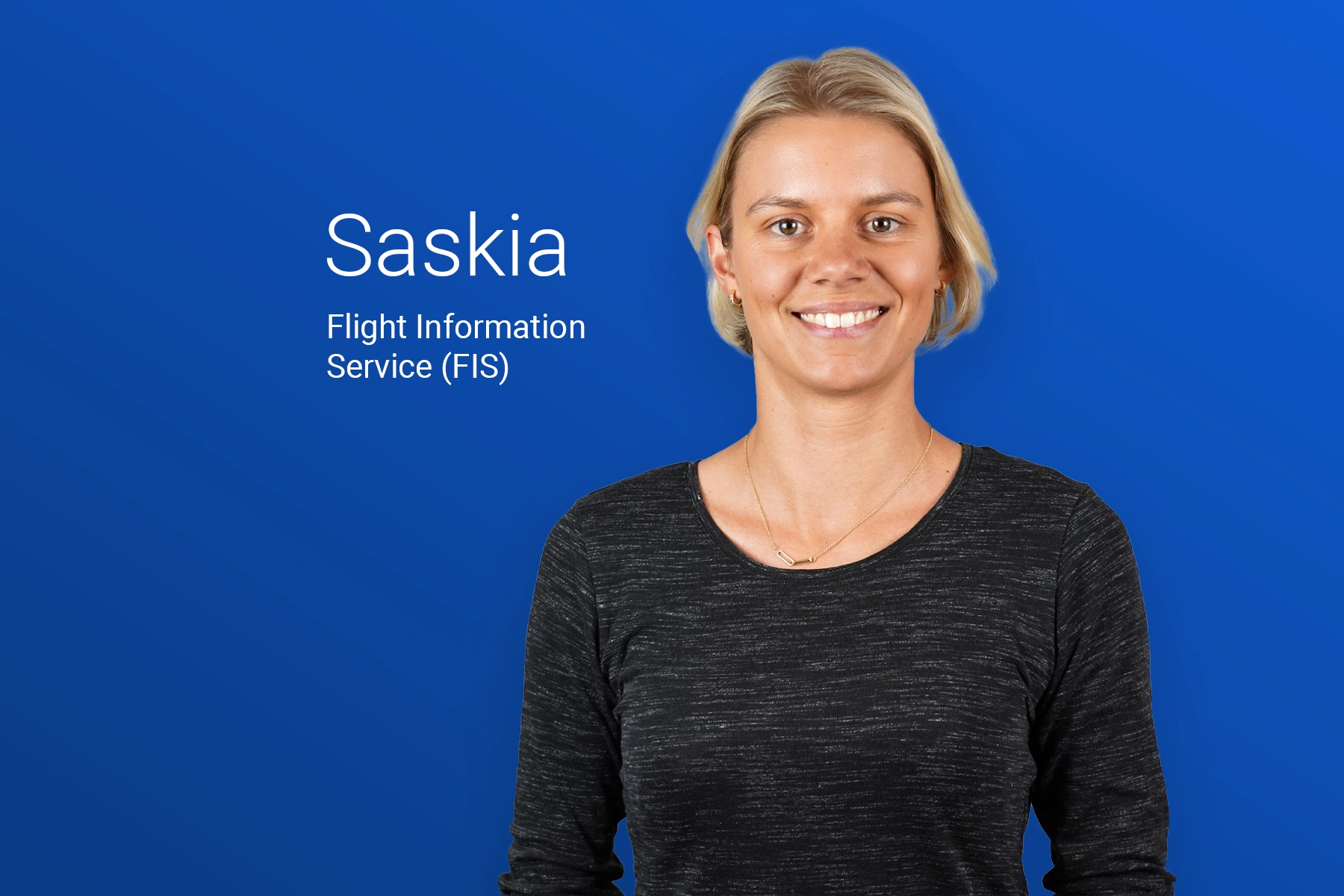
Saskia Maack Flight Information Service FIS
The career so far
"After completing my school-leaving exams, I didn't know exactly what would suit me. But I was already interested in aviation, which then led me to DFS.
I completed my school-leaving exams in 2011 and didn't really know what I wanted to do at first. My uncle is a Lufthansa pilot and my mum is a glider pilot – which is how I got the idea of going into aviation and becoming an air traffic controller. As part of the selection process, I discovered the flight data specialist career profile and decided to take this path. I actually wanted to return to my home city of Bremen. But over time, I felt increasingly at home in Langen. Then came the career option to work as a flight data specialist. This is an exciting job right at the cutting edge of aviation, which suited me perfectly."
The motivation
"FIS in Germany is one of the best, as we specialise in this area and have a dedicated department.
Unlike many other countries, the job profile of flight data specialist in Germany is centralised at one location. From our Langen Campus, we provide support from the FIS centre to all pilots flying under visual flight rules, or VFR, throughout Germany wishing to make use of our service. We are around 45 colleagues and see ourselves as a dedicated team. Helping VFR pilots in complex situations can definitely be very challenging. But when our work helps pilots get out of a tricky situation, you can tell how grateful they are on the radio. This is really motivating and underlines the importance of the FIS service for safety in the skies. We sometimes even receive a postcard as a thank you. As you can see, this really is a unique job at a unique company. That really appealed to me."
The activities
"Although we don't give VFR pilots any instructions, our information is vitally important for them.
We monitor the airspace up to an altitude of around 3,000 metres. The range for VFR pilots ends at this altitude in Germany. A VFR flight is one that is performed by the pilot under visual flight rules. Pilots make their own decisions, although they can always rely on our support, for example in the event of orientation issues. The counterpart to visual flight rules is instrument flight rules, or IFR. Passenger aircraft of airlines, for example, fly based on applicable instrument flight rules. These are controlled by our air traffic controllers. Accordingly, we have both IFR and VFR traffic within our airspace as aircraft taking off and landing ultimately all fly through VFR airspace.
Our airspace is divided into 11 visual flight sectors. I generally manage one or two of these at the same time. In total, I hold licenses for half of these sectors. Mine are all located in northern Germany. Since we work with VFR pilots, we don’t have any night shifts. You can say that we more or less work around the sunrise and sunset times. In summer, we’re open from 6:00 to 22:00 hrs, in winter from 7:00 to 20:00 hrs. While on duty, I talk to many different VFR pilots. I use radiotelephony to give traffic and meteorological information, among other things. In terms of meteorological information, we have access to data from the German Meteorological Service (DWD). For example, if weather develops that was previously unforeseeable and a pilot loses their orientation, I help them out of the area."

"If you’re looking for outstanding job security in your career, DFS is the right place for you.
The challenges
"Emergencies can certainly be very challenging.
Unforeseen issues can occur at any time, such as engine, electrical power or radio problems. Or when novice pilots with little experience find themselves in tricky situations. The key for me in these cases is to remain calm and provide help with all the information I have at my disposal. My goal is to give pilots the feeling that they’re in good hands and will receive the support they need.
In summer, it can get pretty stressful at weekends, as there's a lot going on in the skies. Once pilots have landed, they are required to give notice on our frequency – which they sometimes forget to do. Other times, they can’t get through because the frequency load is too high on some days. I then have to follow up and make sure that they’ve landed safely.
Sport offers me the distance from my work, and the balance I need from the sometimes demanding daily work routine. I really enjoy boxing in my free time, as it's a great outlet for relieving stress."
The corporate culture
"The hierarchies are flat and the interactions within the team are fantastic.
Our team is quite young, but the working relationships with older colleagues are also always open and respectful. The atmosphere is relaxed, as everyone knows what they have to do and that they can always rely on each other. Since we have such specialised jobs that you can't easily start anywhere else, DFS is keen to keep entrusting us with new duties. I'm also involved in the FIS public relations team, where I can contribute to podcasts and give presentations, for example for flying schools or associations."

Your future:
safety in the sky
Become part of our close-knit team
Do you have questions about DFS as an employer?
Simply get in touch with our careers team:
karriere@dfs.de